Table of Contents
Toggle- Summary
- Introduction
- Can Anomaly Scan Detect Down Syndrome?
- What Does the Anomaly Scan Look for in Down Syndrome?
- Can a Baby Have Down Syndrome Even With a Normal Anomaly Scan?
- What Tests Are More Accurate for Detecting Down Syndrome?
- Why is the Anomaly Scan Still Important?
- When Do Doctors Recommend Further Testing?
- What If Soft Markers Are Seen in the Scan?
- Conclusion
- FAQs
- 1. Can Down syndrome be missed in an anomaly scan?
- 2. Is NIPT more accurate than an anomaly scan for Down syndrome?
- 3. Can soft markers disappear later in pregnancy?
- 4. Are all babies with soft markers affected by Down syndrome?
- 5. What happens if the anomaly scan shows a marker?
- 6. Does maternal age affect Down syndrome risk?
- 7. Can an anomaly scan detect other chromosomal disorders?
Summary
- An anomaly scan can detect around 50% of Down syndrome cases by identifying certain physical traits, called soft markers.
- A normal anomaly scan does not rule out Down syndrome completely, since some babies show no visible markers at all.
- Tests like NIPT, CVS, and Amniocentesis are far more accurate and are recommended when risk is suspected.
Introduction
The fetal anomaly scan, usually done between 18 and 22 weeks, is one of the most detailed ultrasounds in pregnancy. While its primary purpose is to check the baby’s physical development, many parents ask whether it can also detect Down syndrome. The short answer is that it can raise suspicion, but it cannot confirm a diagnosis.
Schedule an Anomaly Scan with Dr. Deepthi Jammi Today
Can Anomaly Scan Detect Down Syndrome?
Yes, to an extent.Certain physical features linked to Down syndrome can sometimes be picked up during the anomaly scan.
However, since chromosomal conditions can only be confirmed by examining the baby’s cells directly, ultrasound alone cannot diagnose Down syndrome; it can only indicate an increased likelihood based on physical signs.
What Does the Anomaly Scan Look for in Down Syndrome?
The scan checks for soft markers, minor variations that occur more often in babies with Down syndrome. These include:
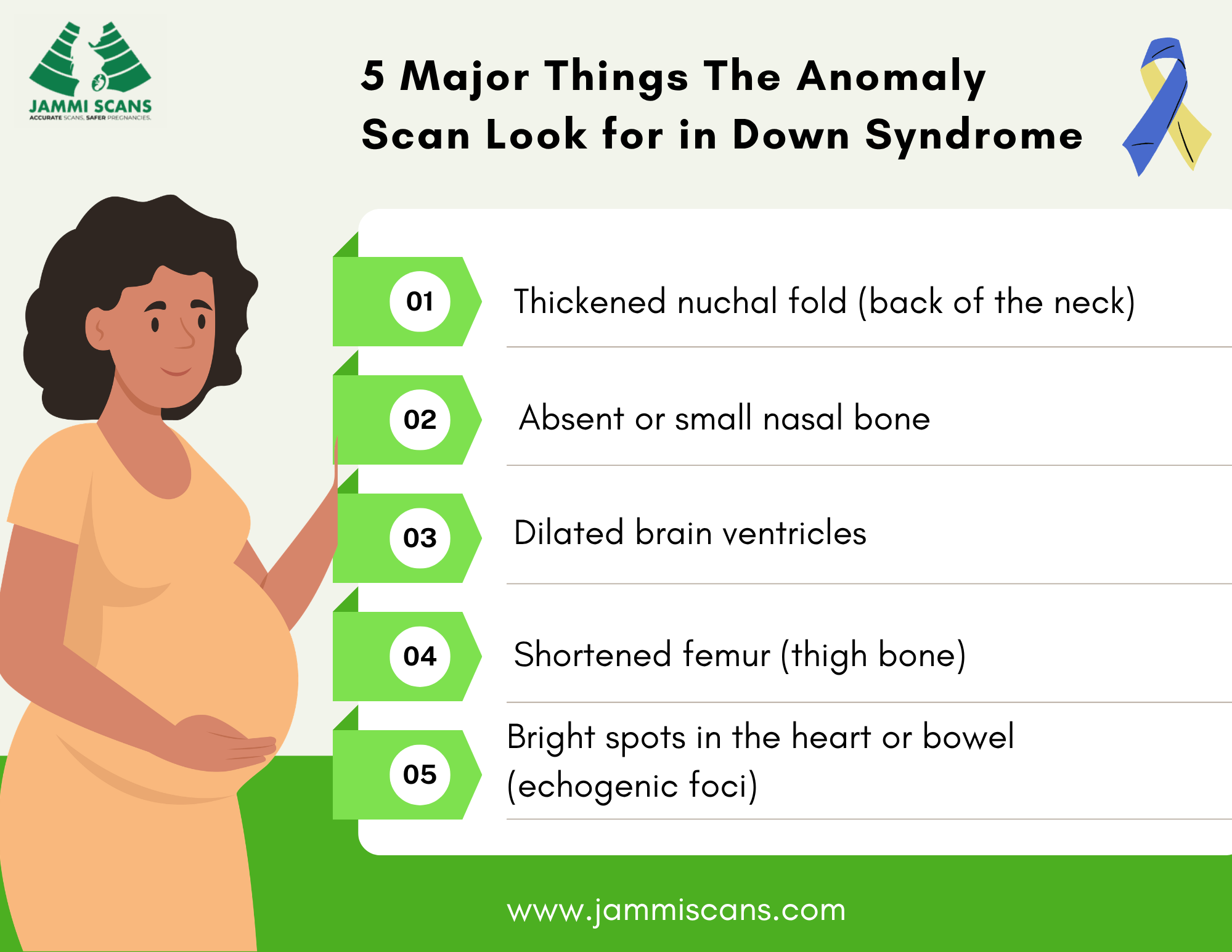
- Thickened nuchal fold (back of the neck)
- Absent or small nasal bone
- Dilated brain ventricles
- Shortened femur (thigh bone)
- Bright spots in the heart or bowel (echogenic foci)
A single marker doesn’t confirm Down Syndrome Doctors weigh the combination of findings against the baby’s overall development.
Can a Baby Have Down Syndrome Even With a Normal Anomaly Scan?
Yes, a completely normal-looking scan does not rule out down syndrome. Some babies with Down syndrome show no visible markers at all, which is why the anomaly scan is not treated as a standalone screening tool for chromosomal conditions.
What Tests Are More Accurate for Detecting Down Syndrome?
For a clearer risk assessment, doctors rely on:
- CVS (Chorionic Villus Sampling): A placental tissue sample offering a definitive chromosomal diagnosis, usually done between 11 and 14 weeks.
- Amniocentesis: An amniotic fluid sample, also diagnostic, typically performed after 15 weeks.
Why is the Anomaly Scan Still Important?
Even though it isn’t diagnostic for chromosomal conditions, the anomaly scan remains essential.
It checks the baby’s organs, limbs, spine, and brain in detail and can identify structural conditions unrelated to down syndrome, such as heart defects, that need early attention regardless of chromosomal status.
When Do Doctors Recommend Further Testing?
Doctors usually recommend further testing after the anomaly scan if it picks up one or more soft markers, or if there’s a known family history of chromosomal conditions. That said, testing isn’t always postponed till this stage.
If an earlier screening step, such as the NT scan, already pointed to a higher risk, your doctor would generally suggest moving ahead with further testing post scan without having to wait for the anomaly scan.
What If Soft Markers Are Seen in the Scan?
Finding a soft marker may require further evaluation not an immediate diagnosis. Your doctor will consider it alongside your earlier screening results, your age, and the rest of the scan findings before deciding if further testing is needed.
Does Seeing a Marker Mean Something Is Wrong?
Not necessarily. Soft markers are common and often appear in babies with no chromosomal conditions at all. Some may resolve or become less apparent. as pregnancy progresses. It’s a prompt for further evaluation, not a confirmed problem.
Conclusion
An anomaly scan is a valuable tool for checking your baby’s physical development, but it can only detect around half of Down syndrome cases and cannot confirm a diagnosis on its own.
If your scan shows a soft marker or if you’d like expert guidance on your results, get in touch with Jammi Scans, located at 14, Jagadeeswaran St, T. Nagar, Chennai.
Dr. Deepthi Jammi and her team offer detailed anomaly scans and accurate risk assessment to help you make informed decisions with confidence. Call +91 7338771733 or WhatsApp +91 9150719997 to book your appointment.
FAQs
1. Can Down syndrome be missed in an anomaly scan?
Yes. Some babies with Down syndrome show no visible markers and can be missed.
2. Is NIPT more accurate than an anomaly scan for Down syndrome?
Yes. NIPT has a detection rate above 99%, compared to for the anomaly scan alone.
3. Can soft markers disappear later in pregnancy?
Yes. Some soft markers, like a bright spot in the heart, often resolve or become less visible as the pregnancy progresses.
4. Are all babies with soft markers affected by Down syndrome?
No. A soft marker does not always mean the baby has Down syndrome. Most babies with an isolated soft marker are born without any chromosomal condition.
5. What happens if the anomaly scan shows a marker?
Your doctor will weigh it against your earlier screening results and may suggest NIPT, CVS, or amniocentesis for a clearer answer.
Note that this decision isn’t always tied to the anomaly scan itself; if an earlier test like the NT scan already flagged higher risk, this conversation would typically happen sooner.
If you’d like to discuss your results with a specialist, you can reach Dr. Deepthi Jammi at Jammi Scans by calling +917338771733.
6. Does maternal age affect Down syndrome risk?
Yes. The risk increases with maternal age, particularly after 35, though Down syndrome can occur at any age.
7. Can an anomaly scan detect other chromosomal disorders?
It can raise suspicion for other conditions like Edwards syndrome (Trisomy 18) or Patau syndrome (Trisomy 13) through similar structural markers, but confirmation still requires diagnostic testing.
Reviewed by Dr. Deepthi Jammi - Fetal Medicine Specialist
Dr. Deepthi Jammi (Director, Jammi Scans) is a qualified OB/GYN and Post-Doc in Maternal Fetal Medicine. As a pregnancy ultrasound expert, she is passionate about healthy pregnancies and works towards spreading awareness on the latest diagnostic options available for parents to choose from. Dr.Deepthi has received gold medals and awards in Fetal Medicine at international and national conferences, and has appeared in numerous prestigious regional magazines and TV interviews.