Table of Contents
ToggleSummary
Medically Reviewed by Dr. Deepthi Jammi, MS (OB/GYN), Fetal Medicine Specialist – 15+ Years Experience
- The anomaly scan analyses all the organs and major structures for any abnormalities.
- It can detect over 200 abnormalities, which allows for early detection and treatment.
Introduction
The anomaly scan is one of the most important milestones in your pregnancy journey. It is a systematic, head-to-toe assessment of your baby’s anatomy.
It helps expectant parents to feel reassured, be informed, and be prepared regarding their baby’s development.
Anomaly Scan Video
Why is an Anomaly Scan important?
The anomaly scan is performed during a specific window when the baby is sufficiently developed to be clearly seen on an ultrasound, yet still early enough for doctors and parents to make informed decisions if any concerns arise.
Early identification is the main goal of an anomaly scan. It allows the medical team and parents to plan for the birth, arrange specialists, or perform prenatal interventions where needed.
It also allows parents to seek counselling and fully understand any condition, because being informed is always better than being caught unprepared at delivery.
What Does an Anomaly Scan Do?
An anomaly scan is done to methodically evaluate the structure and development of your baby.
It thoroughly checks each organ, whether it is present, correctly formed, positioned in the right place, and does not appear abnormal.
It also looks at the placenta, amniotic fluid levels, and the umbilical cord.
What Major Organs Can We See in an Anomaly Scan?
The anomaly scan involves a systematic evaluation of the following structures of the fetus:
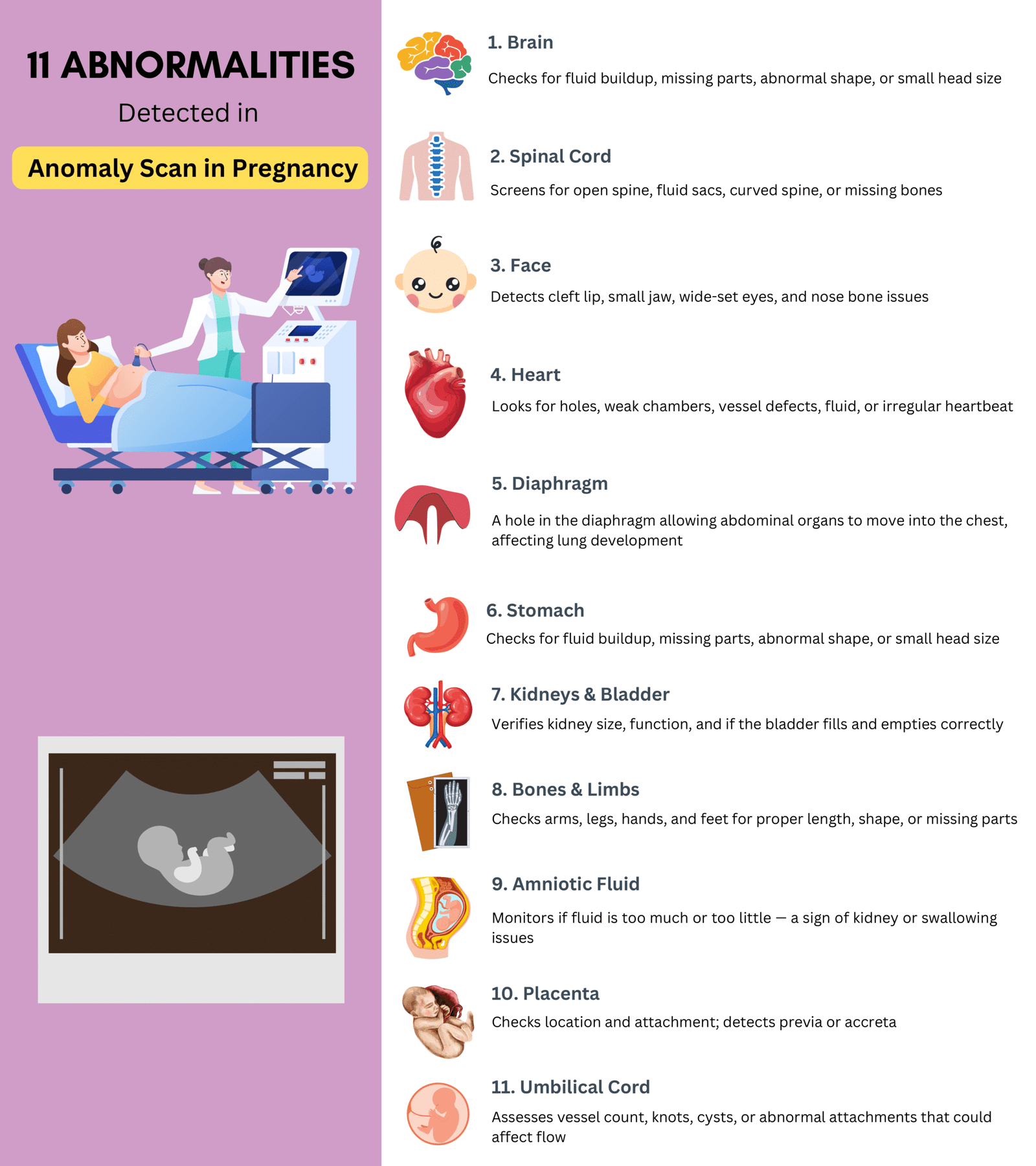
- Brain – ventricles, cerebellum, and cavum septum pellucidum
- Spinal cord – viewed from head to tail for any gaps or anomalies
- Face – Abnormalities with nose, chin, lips, eyes, and other facial structures
- Heart – four chambers, outflow tracts, and large blood vessels
- Diaphragm – checked for any holes or rifts between the chest and abdomen
- Stomach – to establish that the fetus swallows amniotic fluid
- Kidney – checked for position, number, and structure
- Bones – limbs, bone structure, and movement assessed
- Amniotic Fluid – levels checked to ensure they are normal
- Placenta – location confirmed; checked for low-lying placenta
- Umbilical Cord – checked for normal structure and blood flow
What Can Be Identified in an Anomaly Scan?
The following is identified in an anomaly scan:
- Detects more than 200 abnormalities in fetal structures
- Confirms that all major organs are normal and in the right place
- Identifies the position of the placenta (including low-lying placenta or placenta previa)
- Assesses amniotic fluid levels
- Provides an updated measurement of fetal size
- Flags concerns with varying degrees of certainty; some findings are definitive, while others may only indicate a risk of chromosomal conditions.
What are the Limitations of the Anomaly Scan?
The anomaly scan is a powerful tool, but parents should be aware of its limitations:
- Not all abnormalities are visible – subtle heart defects may only appear after birth; functional conditions (affecting how an organ works, not its structure) cannot be seen on ultrasound.
- Chromosomal conditions cannot be diagnosed – Down syndrome and similar conditions cannot be confirmed by the scan alone; soft markers can only raise suspicion, not provide a diagnosis.
- Image quality varies – the baby’s position, amniotic fluid levels, the mother’s body habitus, and equipment quality can all affect how clearly structures are seen.
- Some abnormalities develop later – conditions that appear or worsen after 22 weeks may not be detectable at the time of the scan.
- Isolated cleft palate – can be harder to detect as the palate is inside the baby’s mouth, making it difficult for ultrasound waves to visualize clearly.
Does an Anomaly Scan Guarantee a Healthy Baby?
- An anomaly scan is reassuring and shows the baby is developing as expected, but it is not a guarantee of a perfectly healthy baby.
- Some conditions simply cannot be detected on any ultrasound
- Conditions that develop later in pregnancy may not be detected during an anomaly scan.
- Functional conditions, genetic diseases without physical defects, and rare syndromes will not be visible.
- Parents should view the scan as a vital diagnostic tool, one that significantly improves the chances of identifying a problem early.
Conclusion
The anomaly scan is an important part of prenatal care. When done carefully, it gives both the doctors and the parents a clear picture of the baby’s development at a stage when it matters the most.
Dr. Deepthi Jammi at Jammi Scans uses the latest technology and maintains open communication with parents so they fully understand what the scan shows and what it means for them.
For more information regarding fetal medicine services or to schedule a consultation with Dr. Deepthi Jammi in Chennai, dial 733 8771 733.
Reviewed by Dr. Deepthi Jammi - Fetal Medicine Specialist
Dr. Deepthi Jammi (Director, Jammi Scans) is a qualified OB/GYN and Post-Doc in Maternal Fetal Medicine. As a pregnancy ultrasound expert, she is passionate about healthy pregnancies and works towards spreading awareness on the latest diagnostic options available for parents to choose from. Dr.Deepthi has received gold medals and awards in Fetal Medicine at international and national conferences, and has appeared in numerous prestigious regional magazines and TV interviews.