

Table of Contents
ToggleSummary
Medically Reviewed by Dr. Deepthi Jammi, MS (OB/GYN), Fetal Medicine Specialist – 15+ Years Experience
- An anomaly scan in a twin pregnancy is done during 18–22 weeks to check how both babies are developing.
- It detects structural abnormalities, growth differences, and assesses placenta and fluid levels.
Introduction
A twin pregnancy brings double the excitement, but needs closer monitoring than a single pregnancy.
Since two babies are growing at the same time, your doctor needs a clear picture of how each one is developing.
This is where the anomaly scan becomes important. Though it’s routine in all pregnancies, it becomes even more critical when you’re expecting twins.
Schedule an Anomaly Scan with Dr. Deepthi Jammi Today
Anomaly Scan Twin Pregnancy
Is an Anomaly Scan Necessary in a Twin Pregnancy?
Yes, it is absolutely necessary for the following reasons:
- Twin pregnancies come with higher risks compared to single pregnancies.
- Studies show that congenital anomalies can occur more frequently in twins. Sometimes affecting one baby and sometimes both.
- There is also a higher chance of complications, such as growth differences, preterm birth, and issues related to a shared placenta.
How is an Anomaly Scan Different for Twins?
The purpose of the scan remains the same. To check the babies’ development.
In a single pregnancy, the focus is on one baby. In a twin pregnancy anomaly scan, everything is done twice.
This means the scan may take longer. And needs more careful observation.
A twin pregnancy anomaly scan helps doctors:
- Detect structural abnormalities in each baby
- Compare the growth of both babies
- Check whether they share a placenta and an amniotic sac or have separate ones
- Monitor conditions like Twin-to-Twin Transfusion Syndrome (TTTS)
Types of Twin Pregnancies
Twin pregnancies are classified in two main ways:
Based on How Twins are Formed
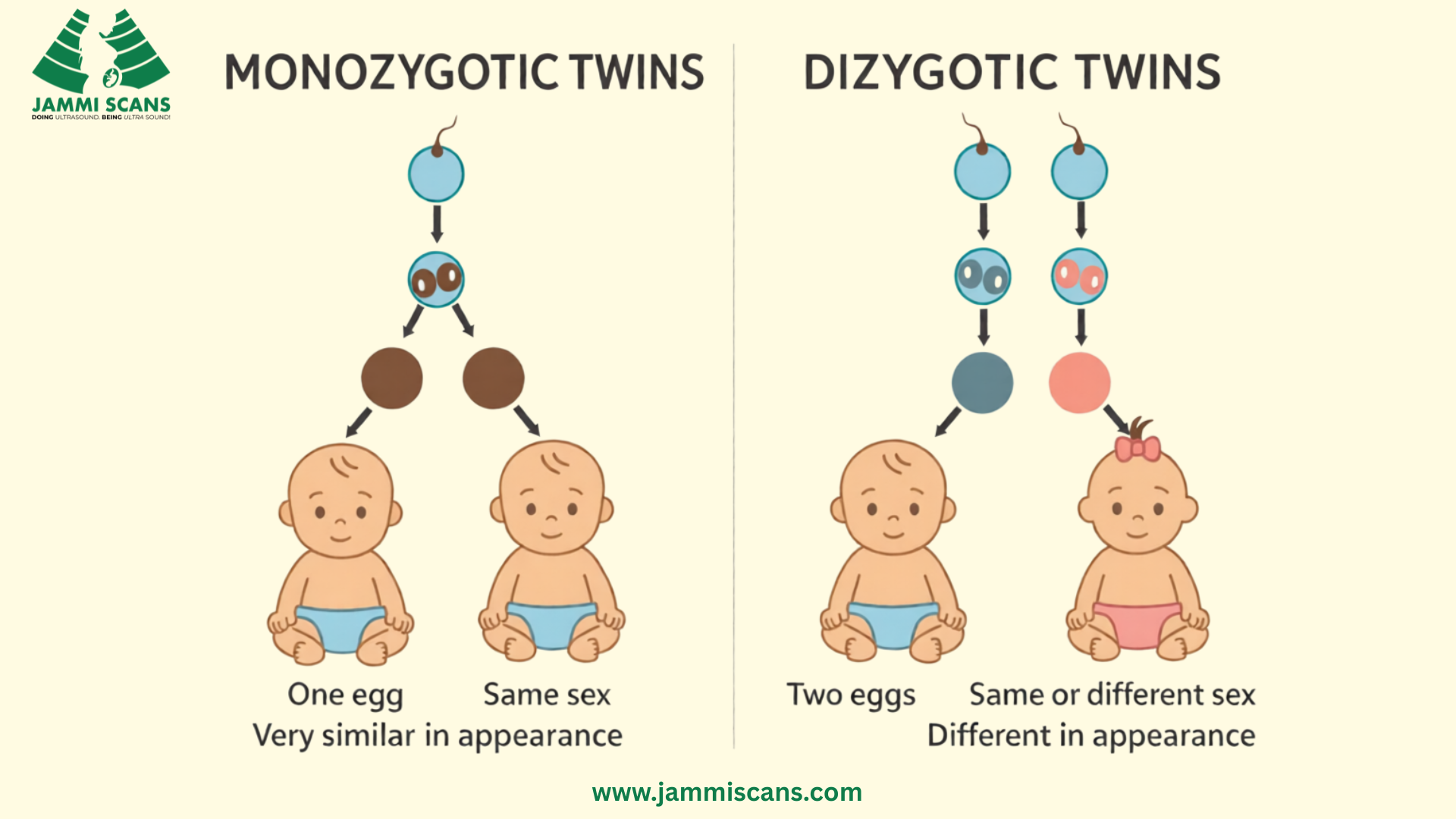
- Monozygotic (Identical twins): One fertilised egg splits into two.
- Dizygotic (Fraternal twins): Two separate eggs are fertilised.
Based on the Placenta and Amniotic Sac
- Dichorionic Diamniotic (DCDA): Each baby has a separate placenta and amniotic sac.
- Monochorionic Diamniotic (MCDA): Both babies share a single placenta but have separate amniotic sacs.
- Monochorionic Monoamniotic (MCMA): Both babies share one placenta and one amniotic sac. They are of two types:
- Conjoined (Siamese) Twins: A rare type where the fertilised egg does not fully split, so the babies remain physically connected.
- Non-Conjoined Twins: Both babies are separate.
Challenges in Performing an Anomaly Scan in Twin Pregnancy
Some common challenges include:
- The fetal medicine specialist needs to clearly identify and track each baby (Twin A and Twin B), but since babies keep moving, this can be difficult.
- Sometimes one baby may block the view of the other, making it harder to see all the organs clearly.
- Checking whether the placenta is shared or separate can also be challenging.
- As the babies grow, space inside the womb becomes limited, making it harder to get clear images. Hence, doctors may use a transvaginal scan for a better view.
- The anomaly scan in a twin pregnancy takes more time. Hence, require more expertise and patience.
What Do Doctors Check in Twin Pregnancy?
The objective of an anomaly scan is the same for both single and twin pregnancies.
But in a twin pregnancy anomaly scan, doctors check the following parameters:
- Identify and label each baby clearly to track them correctly in future scans.
- All major organs of both babies are examined.
- Check whether the placenta and amniotic sac are shared or separate.
- Measure amniotic fluid around each baby.
- Look for any growth differences between them.
- They check the umbilical cord and blood flow.
- Screen for twin-specific conditions like twin-to-twin transfusion syndrome (TTTS).
Why Expert Scanning Is Important for Twins?
Anomaly scans in twin pregnancies are more complex than regular scans, so having an experienced fetal medicine specialist is very important.
- They have advanced training to detect complex issues that may not be easily identified in a routine scan.
- Since there are two babies, and they may overlap or keep moving, it takes skill to get clear and accurate images.
- If any concerns are found, they can counsel parents and guide the next steps immediately.
- They use high-quality equipment, like Doppler and 3D/4D scans, to get clearer images.
Conclusion
An anomaly scan plays a key role in a twin pregnancy. It helps doctors check both babies carefully. And plan the right follow-ups.
As twin pregnancy anomaly scans are more complex, choosing the right fetal medicine specialist is important.
At Jammi Scans, your scan is performed by Dr Deepthi Jammi, an experienced fetal medicine specialist with strong expertise in evaluating twin pregnancies.
With advanced technology and detailed assessment, you receive precise findings and well-informed care at every stage.
To schedule your anomaly scan, call 7338771733 and book an appointment.
FAQ
1. When is the anomaly scan for twins?
The anomaly scan for twins is done between 18 and 22 weeks, when the babies’ organs are developed enough for a detailed assessment.
2. How much do anomaly scans typically cost in Chennai for twins or triplets?
For twin or triplet pregnancies, anomaly scans in Chennai usually cost between ₹4,000 and ₹8,000. The cost depends on the centre, the doctor’s expertise, the scan’s complexity, and the equipment used.
3. How many scans during a twin pregnancy?
A twin pregnancy requires more frequent scans than a single pregnancy, and the exact number can vary from case to case. The frequency depends on the type of twins and how the pregnancy is progressing.
Reviewed by Dr. Deepthi Jammi - Fetal Medicine Specialist
Dr. Deepthi Jammi (Director, Jammi Scans) is a qualified OB/GYN and Post-Doc in Maternal Fetal Medicine. As a pregnancy ultrasound expert, she is passionate about healthy pregnancies and works towards spreading awareness on the latest diagnostic options available for parents to choose from. Dr.Deepthi has received gold medals and awards in Fetal Medicine at international and national conferences, and has appeared in numerous prestigious regional magazines and TV interviews.